

Some Notes, Part 1.
The first named priest of St Michael’s Church was Richard Abel, appointed in the early 14th century. His dates and those of his 56 successors are on a board at the back of the church ( to the right of the tower).
Did Father Abel celebrate Mass and the other six sacraments of pre-Reformation England in the present stone and flint structure? The roof of the present building, incidentally, was thatched until the extensive renovation of the 1860s. Or was there, perhaps, an earlier, humbler building on the same spot, made of wood?
The Old and the New
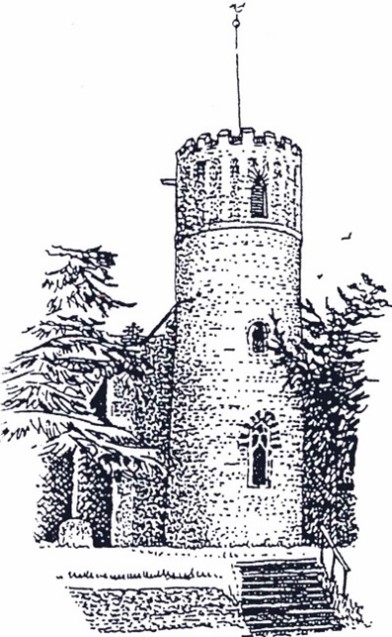
We don’t know when the present church was built, but we can estimate its age from the windows in the nave. They are in the Perpendicular Style, with an immediately recognisable squared-off top. Only three survive because in the mid-1860s the energetic Reverend Daniel Gillett, rector from 1857 to 1883, used his own money and other funds to rebuild the chancel, the area beyond the pulpit. He also added an aisle on the north side of the nave (pictures in the porch show the church’s former appearance).
Strolling round the churchyard, you will see the Revd. Gillett’s initials “D.G.” and the year “1858” on gateposts. His own large headstone is next to the grass path, running north to south across the churchyard above the east window. The rebuilding of the chancel and addition of the aisle was a solid piece of renovation. Yet it is easy to see that the windows in the chancel with their pointed neo-Gothic arches were machine-made. Our resplendent East Window is an even later addition. In the late 1950s Marven Kistruck, a resident and benefactor of Geldeston, summoned the renowned Leonard Walker to make a new stained-glass window for St Michael’s Church. (In the 1930s Mr Walker designed a grand window for a bank in Shanghai.)
Mr Walker moored his houseboat in Geldeston Cut (or Dyke) and worked for weeks to install his striking design. I can remember visiting his daughter there and we went catching tadpoles in the river and nearby ditches.
Church and Village
Why was the church at Geldeston built later than its neighbours, Stockton’s small Saxon church or the mainly Norman building in Gillingham? Unlike them, Geldeston is not mentioned in Domesday Book, William the Conqueror’s great 1086 survey of England. Probably it did not yet exist as a settlement.
From Geldeston along the river to Ellingham stretched the Mickle or Great Fen. As the population grew – there were an estimated 1½ million people in Norman England; 5½ million in Elizabeth I’s time – the Fen was gradually drained, and the present marshes came into being.
The distance between church and village in England has often been explained by the devastation of the Black Death (1349). There is no evidence, archaeological or documentary, to support that theory with regard to Geldeston. The unconscious persistence of the idea depends, I suspect, on our almost universal ownership and use of motor vehicles.
 A Geldeston Miscellany