
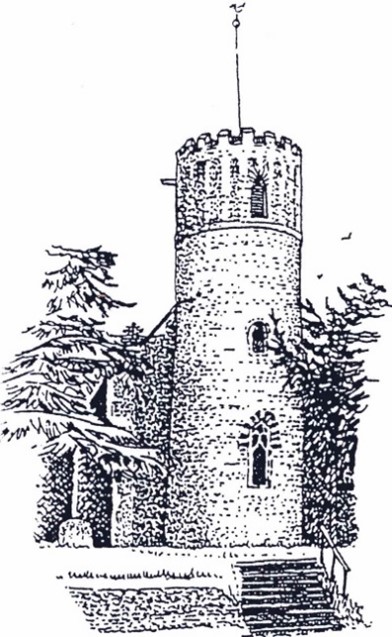
Geldestonians and their Church, Part 2.
(Part 1, see St Michael’s Church).
Walking, riding and driving
In mediaeval times people were accustomed to walked long distances – to their fields, to church, to market. Many retained that capacity until recent times: the local novelist and linguist George Borrow claimed to have walked from Norfolk to London overnight for a job interview. Our village carpenter, Geldeston’s last dyke reeve, George Boggis (1882-1965) recalled walking from Stockton to Geldeston and back each day to attend our old school. You can see Mr Boggis in several photos at the Wherry of the bowling green where the car-park is now (as a skilled wood-worker, he made his own bowls).
The site of our church and its tower were not remote from the village, as some suggest, because of the Black Death (see Part 1). The church is located where it is because it was on high dry ground, visible and audible from afar. Its bells could be heard all over the parish.
Eight times a day, before the Reformation of the 1500s, the bells would toll as the priest prayed for the souls of the living and the dead; and in the surrounding fields the men and women of the village might pause and pray (as in John Millais’ famous painting, The Angelus).
The church stands among the mortal remains of hundreds of Geldeston’s previous inhabitants. Seven thousand, perhaps, were buried there in “God’s Acre” before the first permanent grave markers appeared. The oldest named grave in our churchyard stands to the right of the porch. Surmounted by a jawless skull, a small headstone marks the spot where Mr William Spore was buried in February 1687. He was 37 years old.
“Such Queer People”
Among the necessary repairs and alterations of the 19th century was the lowering and reinforcement of the increasingly unstable and dangerous bell-tower. The funds to pay for that work were raised, in part, by selling two of our historic peal of three bells. This ‘odd’ behaviour was immortalised in a couplet remembered and passed down by old residents like Mr Boggis:
Geldeston are such queer people
They sold the bells to repair the steeple!
Over the years villagers and visitors have climbed the tower, up three sloping and free-standing ladders. The view is wonderful but most (like me) would not willingly repeat the experience. Churchwarden Mr Jonathon Sayer says that generations of churchwardens have scratched their names on the inner surface of the bricks and stone at the top of the tower.
Inside the Church
Much more could be said about the church and the churchyard.
The Dowson family donated the pulpit. The sisters Maude and Mabel Pocock gave the handsome fitted bookcase at the back of the church next to the door.
We know a fair amount about those from our parish who were killed in Two World Wars, thanks to Jonny Sayer of the British Legion. Commemorated on our War Memorial, some like the Kerriches also have plaques inside the church or separate graves in the churchyard (Victor Bellward).
Wildlife Conservation Area
Since the 1970s, the area around and above St Michael’s Church has been designated a Wildlife Conservation Area.

For the past five years, from 2018 to 2022, the grass in this part of the churchyard has been cut and cleared twice annually, in the late summer and in the autumn, to recreate the now rare habitat of a traditional meadow. As a result, wildflowers and bulbs bloom in profusion every spring and early summer. A variety of birds, mammals, reptiles and insects are made as welcome as all our human visitors.
This practice was guided and supported by the Norfolk Wildlife Trust, the oldest in England (est. 1925). It also honours St Francis’s famous saying: “God gave us two books to study, the Bible and the Book of Nature.”
John Crowfoot
(concluded)
 A Geldeston Miscellany